Gait Retraining from Home for People with lower limb prostheses
Keeping Clinical Insight Close to the Person
Recovery after an amputation doesn't end when someone leaves the hospital. Learning to walk with a prosthesis is an ongoing process of adjusting, building confidence, and fine-tuning. Learning to confidently walk again also is not just about prescribing a walking program, it is about understanding daily movement tasks and designing a program that supports this. Within rehabilitation and training the key movement areas of focus look at:
weight acceptance onto the prosthetic limb
stance time
step length
balance
hip control
knee control
stair negotiation
transitions such as sit-to-stand
For many people, the hardest part can be getting regular, objective feedback without repeated trips back to a clinical setting, meaning feedback doesn't necessarily have to mean a therapist physically standing beside the patient.
The broader principle is that the amputee needs some way of understanding:
“What am I doing now, and what am I trying to change?”
And for a clinician, decision making based on single time point assessments can be difficult. We recently ran a home-based gait and balance assessment to see how well our technology can help.
Assessment at home, in a real setting
Once a level of confidence built alongside an in person clinician is achieved, home based rehabilitation provides the opportunity to bring objective patient led, clinician overviewed rehab into the environment in which the person actually needs to use their prosthesis day to day.
That distinction matters. Walking around a gait laboratory is one thing. Walking:
from the kitchen to the front door
across different surfaces
around furniture
outside
up and down steps
while carrying something
while changing speed
when tired
is another.
Meet the participant
Our participant is an active man in his 50s with a transtibial (below-knee) amputation of the left leg, which followed complications related to diabetes in 2023. He also lives with right-foot neuropathy and right knee pain. Together these make his gait a good example of the complexity clinicians manage every day. Both limbs matter, not just the prosthetic side.
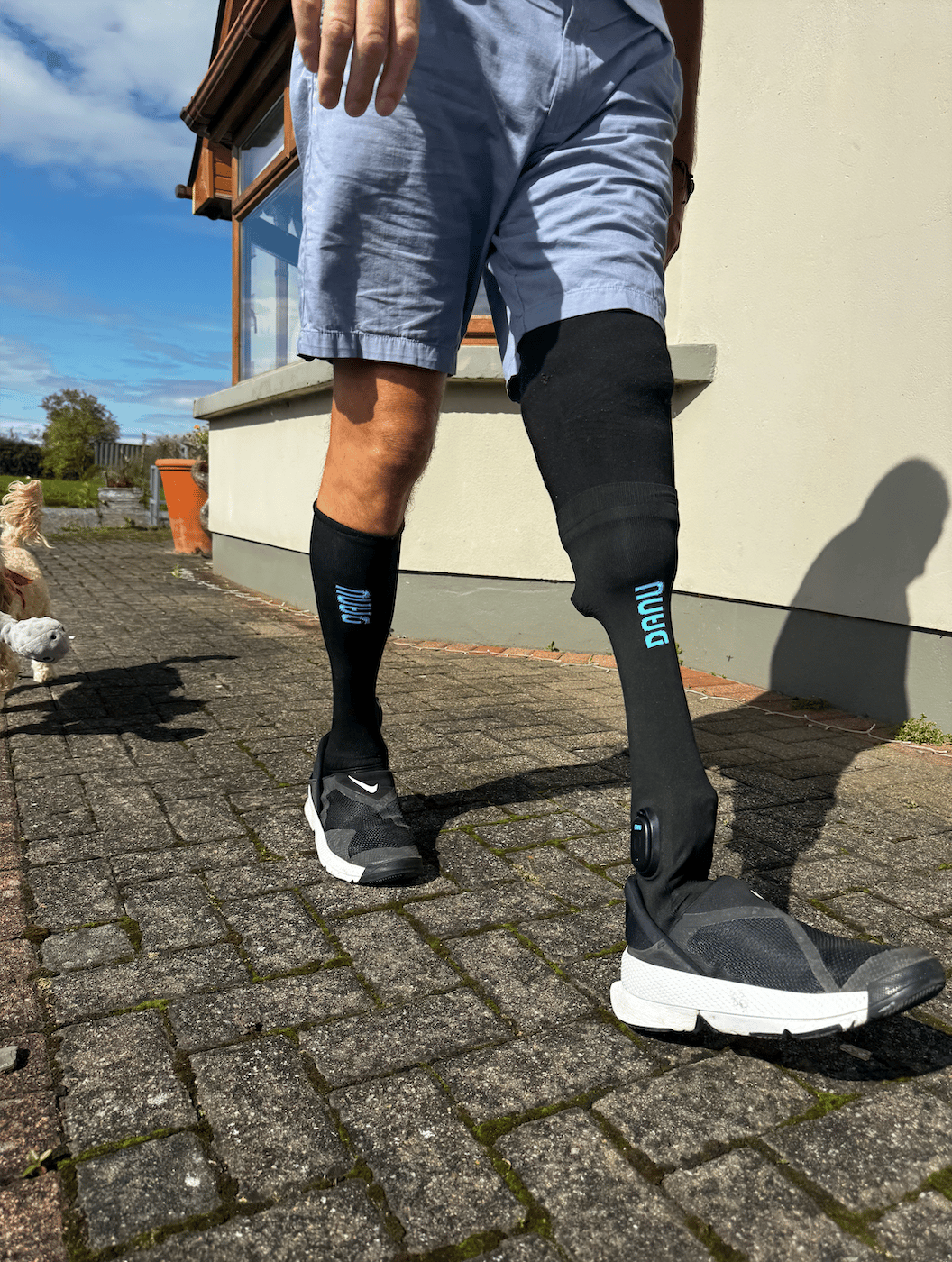
Danu was worn over the prosthetic limb as well as the intact foot. The socks were quick to put on, and our participant found them comfortable. Because the assessment happened at home, he walked in his own environment, in his own shoes, with his own prosthetic setup. That gives a more representative picture of how he actually moves day to day.
What the data showed
The session captured several measures:
Force trace: how load builds and releases through each foot across the entire gait cycle. The two sides showed clearly different loading patterns, which a clinician can look at closely, with more variability evident on the right side. (figure 3)
Centre of pressure: how pressure travels across each foot from initial to final contact, which helps show balance and control. Here we see how the prosthesis on the left side had more of a mid foot initial foot strike in comparison the the right limb who initially struck the ground from the heel.(figure 1)
Asymmetry summary: Comparison of the two sides spatial and temporal walking metrics. With a 61/39 split in total load to the left side, (load reflecting accelerations through the limb), ground contact time minimally longer on the right, with more variability on the right, and a limb dominance score favouring the right.
Some asymmetry is expected after limb loss, and these numbers are not a score or a verdict. They give the care team an objective view at any point in time . Repeated sessions show how gait changes over time as prosthetic alignment, strength, and confidence develop. This also can inform the noted knee pain on the right side and help manage any rehab for the discomfort.
Remote data, clinician-led care
This is not about replacing the care team. The data goes to the clinician, who interprets it, adjusts the rehabilitation plan, and decides when an in-person visit is actually needed. Home assessment adds to clinical expertise and helps it reach people between appointments.

Figure 1: Asymmetry Summary
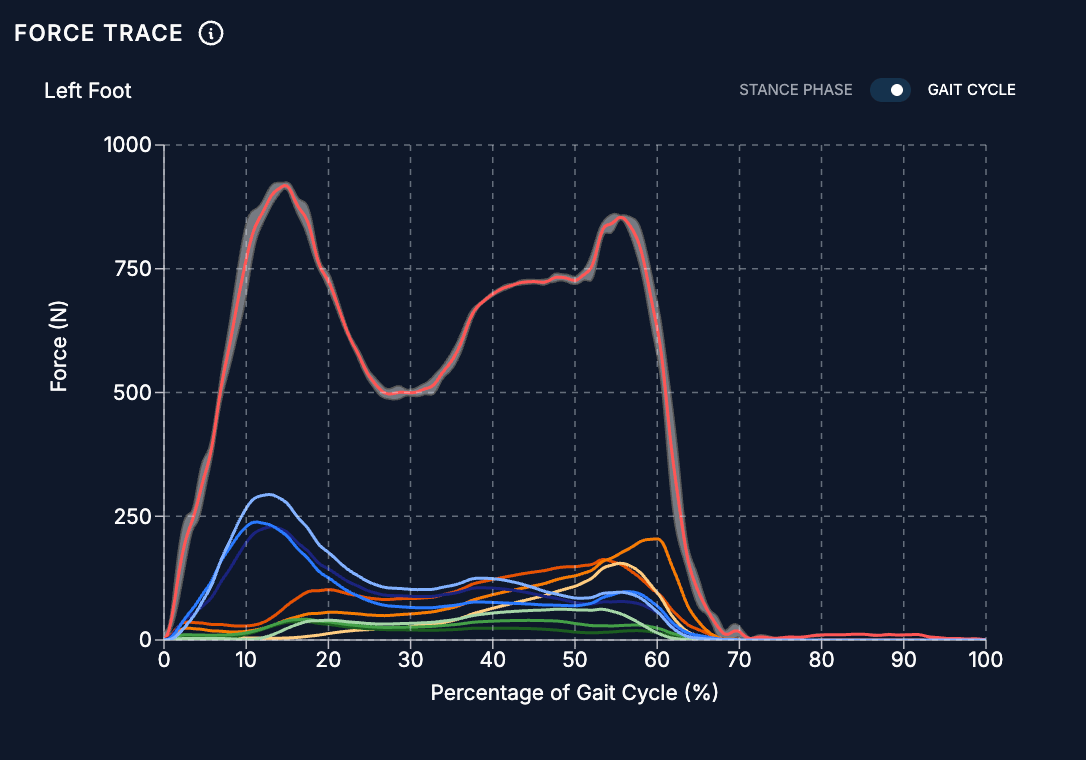
Figure 2: Left Leg (prosthesis) Average Force Trace for the gait cycle
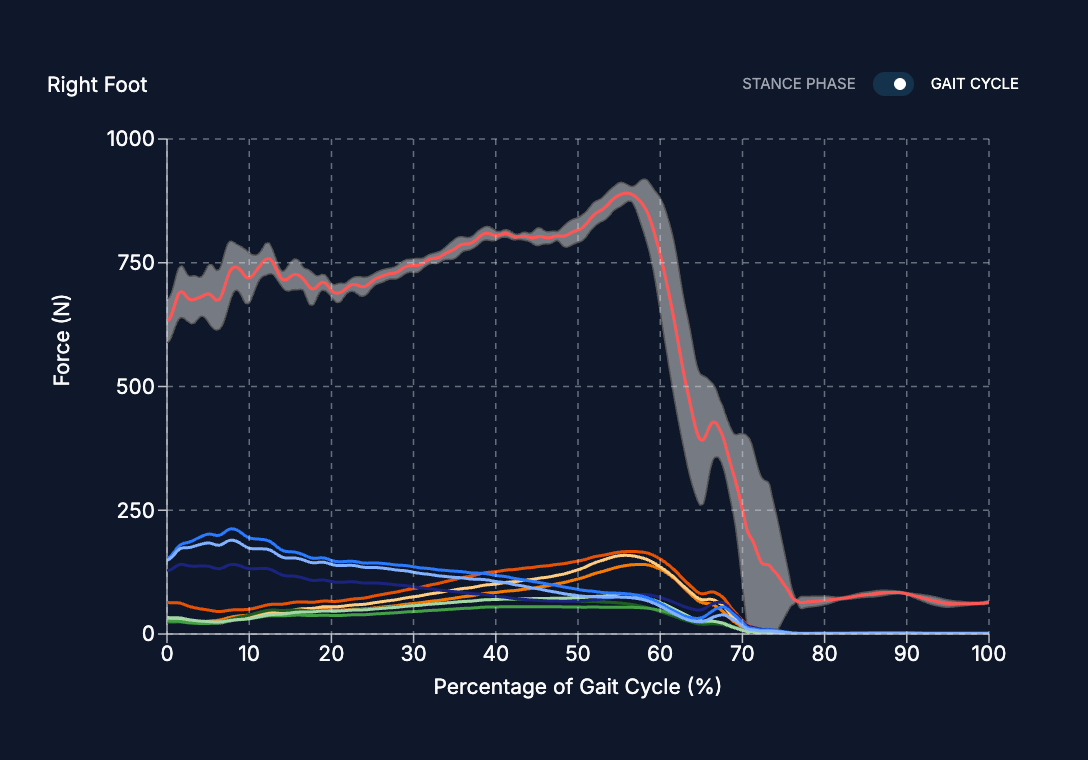
Figure 3: Right Leg Average Force Trace for the gait cycle
References
[1] | Stolycia, M.L., Lunn, D.E., Stanier, W., Walker, J. and Wilkins, R.A., 2024. Biomechanical effectiveness of controlled ankle motion boots: A systematic review and narrative synthesis. Journal of foot and ankle research, 17(3), p.e12044. |
[2] | Liu, J., Valentine, D. and Ebraheim, N.A., 2022. Management of syndesmosis injury: a narrative review. Orthopedic Research and Reviews, pp.471-475. |
[3] | Romero, J.D.L.H., Alvarez, A.M.L., Sanchez, F.M., Garcia, A.P., Porcel, P.A.G., Sarabia, R.V. and Torralba, M.H., 2017. Management of syndesmotic injuries of the ankle. EFORT Open Reviews, 2(9), pp.403-409 |