Quantifying Offloading: Comparing Booted and Natural Gait Using Danu Smart Socks
Ankle syndesmosis injuries, sometimes called “high ankle sprains”, involve damage to the ligaments that connect the tibia and fibula just above the ankle joint (Liu et al., 2022). These injuries can take weeks or months to heal and often require partial weight-bearing or use of an orthopaedic boot to protect the joint during recovery.
It is well established that the goal of an orthopaedic boot is to offload the injured limb, reducing stress while maintaining stability during walking. By immobilising the ankle and redistributing ground reaction forces through the contralateral limb and upper body, the boot helps protect the healing tissues and allows controlled weight-bearing as recovery progresses (Stolycia et al., 2024).
However, until now, the extent of that offloading has been difficult to quantify objectively outside of a biomechanics lab or a doctor’s office. Traditional gait analysis tools such as force plates, pressure maps, or instrumented treadmill systems are accurate but confined to controlled environments. These systems can’t easily show how load changes during real-world walking. Using Danu Smart Socks, it is possible to measure that difference directly. Embedded pressure and motion sensors within the socks capture load distribution in real time.
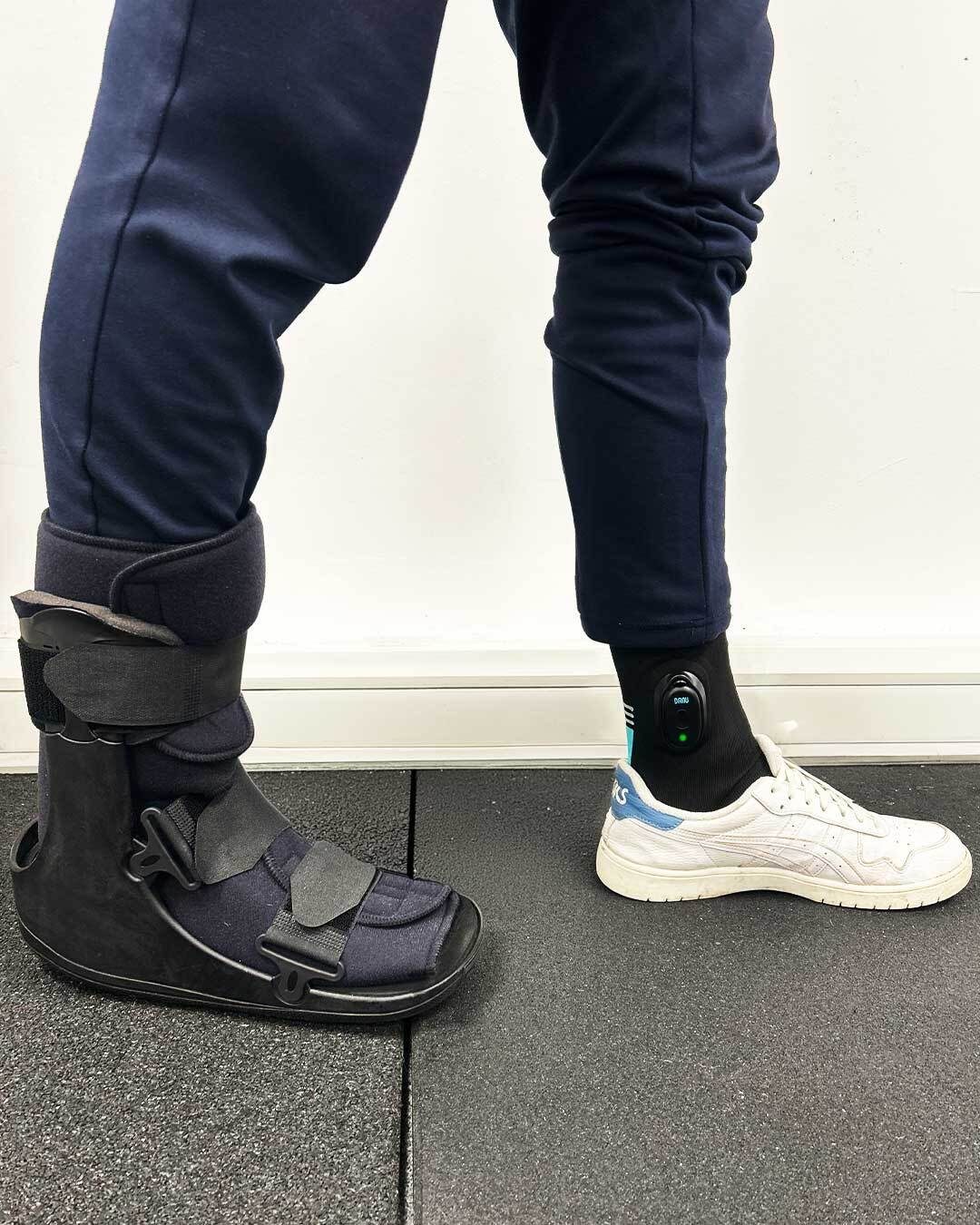
This case presents an individual with a right ankle syndesmosis injury completing two short walks under different conditions.
In Walk 1, the individual wore Danu Smart Socks while wearing their everyday shoes.
In Walk 2, the individual wore Danu Smart Socks, an orthopaedic boot on the injured right limb, and their everyday shoe on the left uninjured limb.
To measure the effect of the boot on offloading during walking gait, the total load experienced by each leg during each session was measured using the Danu Smart Socks. This metric measures the sum of the instantaneous rate of change of acceleration across the 3 axes of movement by each limb individually throughout the session.
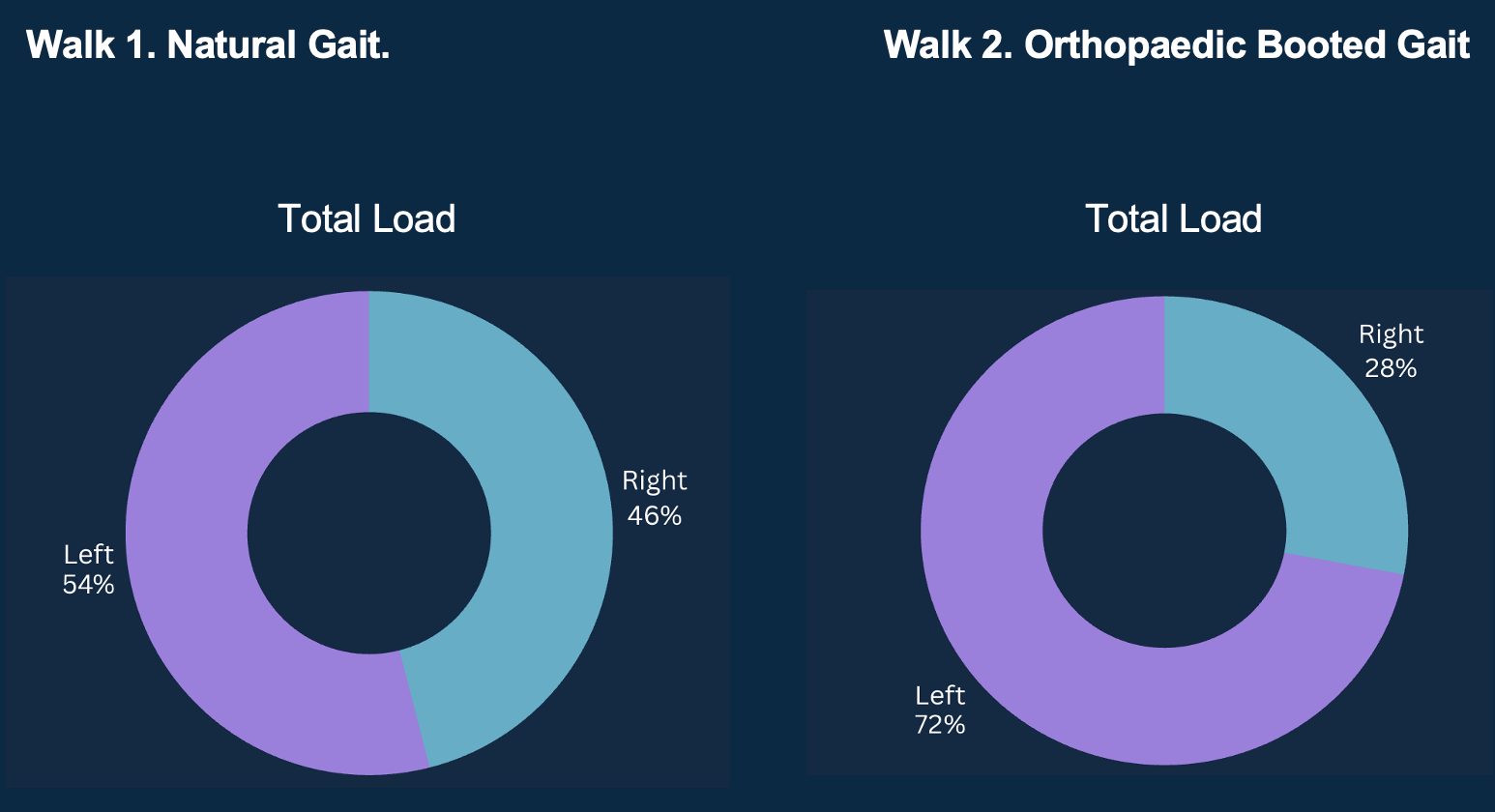
In Walk 1, when walking with everyday shoes, the load distribution was 54% on the left and 46% on the right. In Walk 2, while wearing an orthopaedic boot, the load distribution shifted to 72% on the left, and 28% on the injured right side. This marked change demonstrates that the boot is effectively offloading the injured limb, reducing stress on the damaged structures during walking. For an individual with an ankle syndesmosis injury, this reduction in load is critical in the early stages of recovery to protect healing tissues and allow controlled weight bearing as rehabilitation progresses (Romero et al., 2017). However, the data also illustrates the development of an asymmetrical gait pattern, which clinicians must monitor to ensure compensatory strategies do not persist once the boot is removed.
These findings not only demonstrate the clinical effect of the orthopaedic boot but also highlight the capability of Danu Smart Socks to objectively quantify changes in gait mechanics. The system captures meaningful differences in load distribution between conditions, providing biomechanical insight into how the body adapts to both injury and intervention in real world settings. By detecting these shifts with precision, Danu enables clinicians to evaluate not simply whether an intervention reduces load, but how movement strategies evolve throughout the rehabilitation process.
References
[1] | Stolycia, M.L., Lunn, D.E., Stanier, W., Walker, J. and Wilkins, R.A., 2024. Biomechanical effectiveness of controlled ankle motion boots: A systematic review and narrative synthesis. Journal of foot and ankle research, 17(3), p.e12044. |
[2] | Liu, J., Valentine, D. and Ebraheim, N.A., 2022. Management of syndesmosis injury: a narrative review. Orthopedic Research and Reviews, pp.471-475. |
[3] | Romero, J.D.L.H., Alvarez, A.M.L., Sanchez, F.M., Garcia, A.P., Porcel, P.A.G., Sarabia, R.V. and Torralba, M.H., 2017. Management of syndesmotic injuries of the ankle. EFORT Open Reviews, 2(9), pp.403-409 |